Please note: This article contains references to Native American burials and human remains. It does not contain photographs of human burials or burial objects. It does contain illustrations of nineteenth-century engravings of burial objects, as noted in the captions. The Troost and Jones articles linked to in the "Sources" section contain illustrations of nineteenth-century engravings of Native human remains and burial objects, and detailed descriptions of Native human remains. The Jefferson Street Bridge Project report linked to in the "Sources" section is a redacted edition of the original report and does not contain photographs of Native remains, but it does contain drawings of Native remains, and detailed analyses of each individual burial removed during the project.

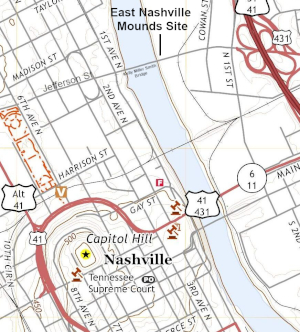
East Nashville Mounds is a Native American historical/archaeological site located on the east bank of the Cumberland River at the east end of the Kelly Miller Smith Memorial Bridge in Nashville, Tennessee. It was a Native town built during the Mississippian culture period and occupied mainly between the years 1250 to 1450. It included at least 4 earthen mounds surrounded by a large stone box cemetery area. One mound was a flat-topped platform mound, the other three were burial mounds. The mounds were relatively intact in the late 19th century. The platform mound partially survived into the late 20th century, but no above ground features are visible today. East Nashville Mounds is a significant historical and archaeological site and is potentially eligible for listing on the National Register of Historic Places. It was recorded with the Tennessee Division of Archaeology in 1971 and given the site number 40DV4 (40 = Tennessee, Dv = Davidson County, 4 = the fourth site recorded in the county). It may have been associated with the French Lick site, 40DV5, another Mississippian town site located directly across the river.
The platform mound at the East Nashville Mounds site is shown on the earliest known map of Nashville, drawn in 1786. It apparently was used as a measuring point for marking off sections of land on the east side of the river. Although it's not labeled, it probably was recognized as an “Indian mound”. Nashville's early citizens were well aware that the city was the location of earlier Native settlements, as shown by the feature labeled “The Mount” on the 1786 map, a platform mound on the west side of the river associated with the French Lick site.

East Nashville Mounds was a known archaeological site at least as early as the mid-nineteenth century. In 1845, Dr. Gerard Troost, Tennessee's first State Geologist, published a paper in Transactions of the American Ethnological Society titled “Ancient Indian Remains in Tennessee”. The paper includes a brief description of the French Lick site on the west bank of the Cumberland as a grave-yard “in the suburbs of our town … about a mile in length” with the stone box graves placed “close to one another … separated only by a single stone”. Troost then mentions the East Nashville Mounds site: “on the other side of the Cumberland river, is another burying ground, where the graves are equally numerous.”
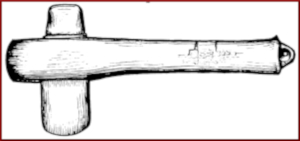
In 1867 and 1868, Dr. Joseph Jones, Nashville's first Health Officer, with funding from the Smithsonian Institution, conducted “explorations” of a number of archaeological sites in Middle Tennessee, including the East Nashville Mounds. Jones excavated the three burial mounds, opening many graves and removing human remains and artifacts. He documented his excavations in an article in The American Naturalist magazine in 1869. A more detailed report was published in Smithsonian Contributions To Knowledge, Number 259, October 1876, titled “Explorations Of The Aboriginal Remains Of Tennessee”.
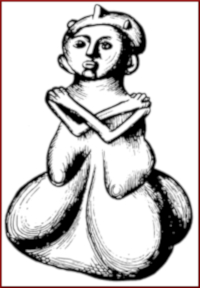
On page 7 of “Explorations”, Jones described the East Nashville Mounds site: “An extensive burying-ground lies on the opposite bank of the Cumberland, directly across from the mouth of Lick Branch, surrounding a chain of four mounds. One of these mounds appeared to have been the burying place of a royal family. Two of the smaller ones are thought to have been the general burying-ground of the tribe, whilst the largest one may possibly have been erected as a site for the residence of the chief, or for a temple. In the low alluvial plain, all around these stone graves, are scattered fragments of pottery, arrow-heads, and other stone implements. The caving of the bluff constantly exposes stone graves, skeletons, and relics of various kinds.”
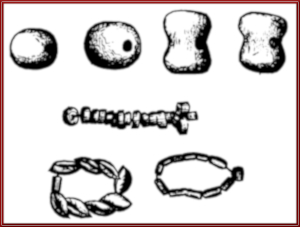
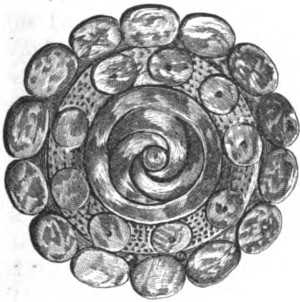
On pages 41 – 50 of “Explorations” Jones documented Native burials he “explored” at East Nashville Mounds, examining and removing human remains as well as artifacts. Some of the burial offerings Jones removed from the burial mounds include a painted triskellion style shell gorget that may have belonged to the town leader, shell bead necklaces, bracelets, a shell bead belt, a conch shell drinking vessel, and a shell ornament carved in the shape of a human face. He also took two copper covered wood disc ear pendants, a light reddish-yellow pottery vase “painted with regular black figures”, a highly polished double-headed stone axe made from green chloritic stone, and triangular stone projectile points. On the surface of the site Jones found “a stone hatchet, and numerous arrow- and spear-heads”. Examining the river banks he “observed strata of ashes and charcoal, pieces of shell and flint, stone implements, and numerous fragments of pottery.” He also noted that the fields around the site “also abound with fragments of pottery, shells, stone implements, and splinters of flint. These remains indicated the occupancy of this locality for a considerable length of time by the aborigines.”
In 1971 amateur archaeologist John Dowd recorded the East Nashville Mounds site with the Tennessee Division of Archaeology (TDOA). At that time the property was owned by the Farris Hardwood Lumber Company and the eastern approach to the Jefferson Street Bridge, built in 1908-1910, crossed the site. Dowd's description of the site's appearance at the time says “No evidence is left of the smaller mounds but much of the large mound is still present.” The owner of the lumber company told Dowd that pottery sherds had been found around the mound and “no excavations had been made there in the fifty odd years he had been there.” An elderly employee also told Dowd that “during the 'great' flood of 1926, that this mound was the only spot above water for miles up and down the river.”
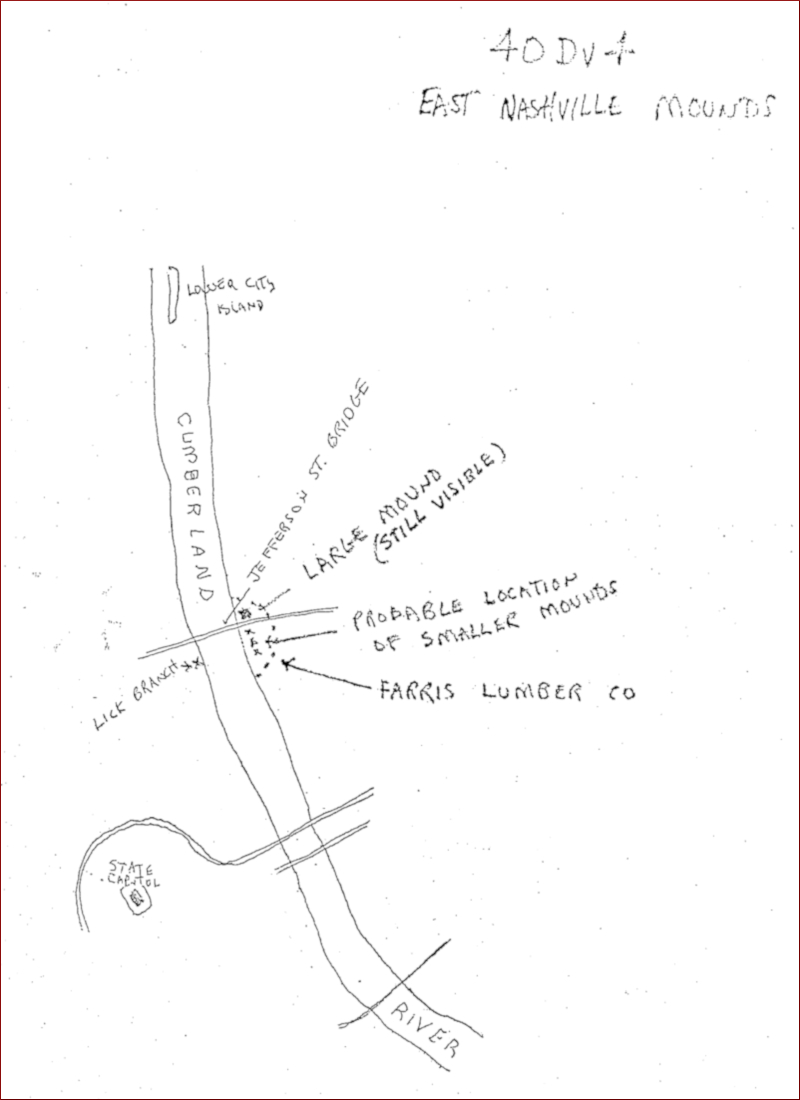
Dowd's hand drawn map in the TDOA site file shows the platform mound adjacent and to the north of the Jefferson Street Bridge, with the probable location of the three burial mounds south of the bridge. In “Explorations”, Jones described the layout of the mounds as a “chain”, with the largest burial mound at the “foot” of the platform mound (pg 41), and the two smaller mounds located about “50 yards higher up the Cumberland” (pg. 49), which would have been to the south of the platform mound and the largest burial mound. Jones gives the size of the largest burial mound as 10 feet high and 100 feet in diameter, and both of the smaller mounds as 4 feet high and 40 feet in diameter. On page 48 of “Explorations” Jones says that graves extended to the river's edge from the burial mounds. The exact boundaries of the town site aren't known, but it may have covered several hundred acres.
From the known location of the platform mound and the probable location of the burial mounds, it's highly probable that construction of the Jefferson Street Bridge in 1908-1910 had a significant negative impact on the East Nashville Mounds site. A postcard dated ca. 1911, shows a photo of the bridge taken from the east side looking west, on the south side of the bridge in the general area of the site. In the foreground a large pile of earth is visible at the east end of the bridge, and the area to the south of the bridge along the river is completely flat. Since this area had not been built on previously, its probable that the bridge construction destroyed any remnants of the burial mounds, although that is just a guess. In any case, it's clear that the largest burial mound, and probably the smaller two, had been obliterated by 1911.
The East Nashville Mounds site was again adversely impacted when the Jefferson Street Bridge was demolished and replaced by the Kelly Miller Smith Memorial Bridge in the early 1990's. Since this project received funding from the Federal Highway Administration, compliance with Section 106 of the National Historic Preservation Act regulations was required. In this case that meant an archaeological survey had to be conducted to determine the project's possible impact on cultural resources. State laws protecting human remains also had to be followed.
In 1988 the Tennessee Department of Transportation (TDOT) conducted a Phase I archaeological survey of the site which found no physical evidence that it still existed, but because of the documentation of the site by Dr. Troost in 1845, Dr. Jones in his reports of 1869 and 1876, and the site file recorded with the TDOA by Mr. Dowd in 1971, a Phase II archaeological investigation of the project right-of-way was needed to comply with Section 106. TDOT contracted with Panamerican Consultants, Inc. (PCI), a cultural resources firm based in Tuscaloosa, Alabama, to do the Phase II work, which began in July, 1991 and included the French Lick/Sulphur Dell site (40DV5) on the opposite side of the river, which would also be impacted by the bridge project. (We'll cover the French Lick site in a separate web page.)
The original Phase II plan for the East Nashville Mounds site was to only excavate the locations where each of 5 bridge support footings would be located, but a stone box burial was found and left in place in the first trench, along with other significant deposits, so the plan was changed to try to determine how much of the entire right-of-way contained cultural resources by cutting a series of backhoe trenches. These tests established that even though the site had previously been impacted by ground disturbing activities, intact archaeological deposits from the Mississippian period were still present throughout most of the project right-of-way, and the site was potentially eligible for listing on the National Register of Historic Places (NRHP).
When a determination has been made that a federally regulated project will adversely impact a site potentially eligible for the NRHP, the agency responsible for the project has to make plans to avoid or mitigate that impact. It was decided that the impact to the East Nashville Mounds site by the Jefferson Street Bridge project couldn't be avoided, so mitigation in the form of Phase III archaeological data recovery began in October, 1991.
In November, 1991, the state of Tennessee filed a Termination of Cemetery petition in Davidson County Chancery Court for the areas impacted by the Jefferson Street Bridge construction on each side of the Cumberland River. Terminating the cemetery would allow the state to legally remove any burials found at the sites, and since the case involved prehistoric Native American burials, the Native members of the Tennessee Archaeological Advisory Council had to be notified. The Alliance for Native American Indian Rights (ANAIR), a local organization formed to oppose the desecration of Native graves, then filed a lawsuit objecting to the Jefferson Street Bridge cemetery termination.
At the time, Native people had never appeared in a termination hearing involving prehistoric burials in Tennessee. The courts routinely misinterpreted state law to require a direct lineal relationship to the deceased for a person or party to be given standing in the case and allowed to testify. ANAIR hoped to establish standing in the termination case by calling a genetics expert as a witness to testify that all Native Americans could trace their ancestry to four women who crossed the Bering Strait thousands of years ago, and therefore Native members of the organization were directly related to the Native people interred at the bridge sites. This argument was never tested, however, as the judge refused to postpone the termination hearing to give the expert witness, a professor from Emory University in Atlanta, time to appear. ANAIR then withdrew it's suit in Chancery Court, intending to file another in federal court, but after a meeting with the Federal Highway Administration, the Tennessee Division of Archaeology, and the state attorney general's office, an agreement was reached that called for reburial of the Native remains within two months on state property near the Natchez Trace. The burial removals began on Dec. 31, 1991. The Tennessee Commission of Indian Affairs rejected the location near the Natchez Trace as a reburial area, and the Native remains were eventually reburied on TDOT right-of-way at the East Nashville Mounds site.
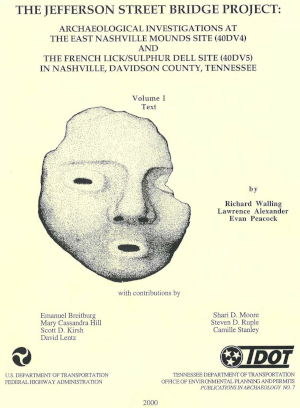
The Phase III field investigations at East Nashville Mounds were completed in January, 1992. In 2000, TDOT published a report on the archaeological work on the bridge project, prepared by PCI, titled The Jefferson Street Bridge Project: Archaeological Investigations At The East Nashville Mounds Site (40DV4) And The French Lick/Sulphur Dell Site (40DV5) In Nashville, Davidson County, Tennessee, Volume I. The report made it clear that the East Nashville Mounds site still contained significant intact cultural resources, including Native burials, as shown in the following references:
Pg. 1 - “although East Nashville Mounds had been impacted by past industrial, transportation, and (probably) agricultural activities, a substantial portion of the Mississippian midden was intact below as much as 1.7 m of historic fill.”
“The types, condition, and distribution of material recovered and observed suggested that the Mississippian remains represented in situ, primary deposits associated with the mound and village complex.”
Pg. 3 - “The Phase II investigation resulted in a recommendation based that the East Nashville Mounds site satisfied the criteria for classification as a significant cultural resource and was potentially eligible for listing in the National Register of Historic Places (NRHP).”
Pg. 120 - “Downstream where the alluvial deosits are wider, a significant segment of the Mississippian town is likely to be preserved.”
It should be noted that downstream referred to on pg. 120 would be to the North of the current Kelly Miller Smith Bridge.
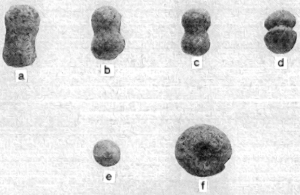
Artifacts and cultural materials documented at East Nashville Mounds by the Jefferson Street Bridge report include 8 hearths, 4 house floor features representing at least two different structures, and 49,938 ceramic artifacts including earplugs, discs, 1 bead, effigies and figurines, jars, pans, assorted bowls, hooded bottles, full figure effigy bottles, and bottles.
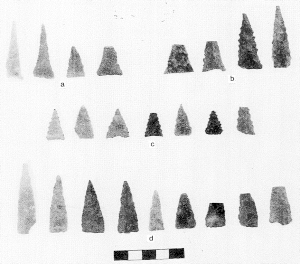
The Jefferson Street Bridge project also recovered a wide variety of stone spear-points, arrow-heads, and tools from the East Nashville Mounds site. The list includes stone projectile points, gravers, microliths, perforators, reamers, hoes, choppers, wedges, abraders, 1 net sinker, hammerstones, milling stones, anvil stones, celts, and discoidals, and many stone tool fragments and the cores that stone tools were made from. The report suggests that the location of the site on the Cumberland River may indicate that the stone celts and wedges found there were used in a dugout canoe industry.
Animal remains found at the East Nashville Mounds site show that the people mainly hunted white-tailed deer, black bear, and elk for food. Mountain lion, skunk, raccoon, squirrel and opossum made up a smaller percentage of their meat consumption, as well as turkey, ducks, geese, pigeon, and other birds. They also ate fish, turtles, freshwater mollusks and snails, and land snails.
The Native people who lived at East Nashville Mounds cultivated corn and squash, and also gathered wild food plants. The most common edible plant food recovered from East Nashville Mounds during the bridge excavations was burnt hickory nut fragments, along with black walnuts. Charred fragments of corn and squash were also found. The corn fragments included a single intact kernel which “seems to have been of large size with no obvious sign of denting, suggesting that it may have been derived from a Northern Flint race.” The Jefferson Street Bridge report states that since “this race of corn was commonly used in prehistoric times in what is now the northeastern portion of the U.S” this indicates “the site occupants had trade interactions with the prehistoric northeastern Native Americans, or at least shared their seed stock.” Other small edible seeds were found, such as purslane, amaranth, and lambsquarter, but they weren't charred so may not have been prehistoric.
The Jefferson Street Bridge report cites evidence that the people at East Nashville Mounds were “experiencing severe environmental stress”, as well as evidence of violent human conflict, and possibly warfare. The main occupation of the site ended in 1450, the same time that most other Mississippian Period towns and settlements in Middle Tennessee and other areas experienced a sharp population decline.
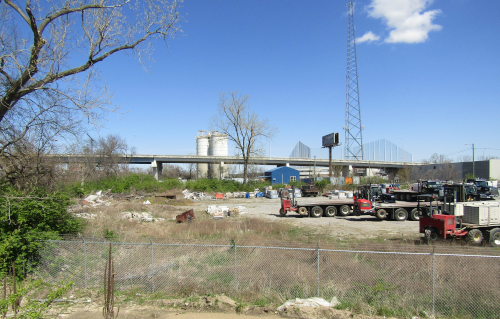
East Nashville Mounds is not a developed historical site and has no interpretive signs or other facilities. The part of the site where the 4 known mounds once stood, adjacent to the Kelly Miller Smith Memorial Bridge on the east bank of the Cumberland river, is on TDOT and private property and is not accessible to the public. But if you cross the bridge and look to the north and south on the east bank, you'll be looking at parts of the site. And if you have ever visited any of the dozens of businesses west of Cowan Street, within about a quarter of a mile of the intersection at Spring Street, you have probably visited the East Nashville Mounds site.
Sources
(Click to open/close the list)
Troost, Gerard. “Ancient Indian Remains in Tennessee”
Transactions of the American Ethnological Society, vol. 1, 1845, p. 358. Digitized by Google books. (This publication contains illustrations of nineteenth-century engravings of Native
burial objects)
Jones, Joseph. "The Aboriginal Mound Builders of Tennessee" The American Naturalist,,
vol. 3, no. 2, 1869, p. 58, pp. 68-71. (This publication contains detailed descriptions of Native human remains and burial objects)
Jones, Joseph. "Explorations Of The Aboriginal Remains
Of Tennessee" Smithsonian Contributions To Knowledge, Number 259, October 1876, p. 7, pp. 41-50. Digitized by Google books. (This publication contains illustrations of
nineteenth-century engravings of Native human remains and burial objects, and detailed descriptions of Native human remains)
Dowd, John. Tennessee Division of Archaeology Site File, 40DV4 East Nashville Mounds Site.
Deter-Wolf, Aaron, and Tanya M. Peres. Mastodons To Mississippians: Adventures in Nashville's Deep Past. Vanderbilt University Press. 2021. p. 96.
Walling, Richard, et al. The Jefferson Street Bridge Project: Archaeological Investigations At The East Nashville Mounds Site (40DV4) And The French Lick/Sulphur Dell
Site (40DV5) In Nashville, Davidson County, Tennessee, Tennessee Department of Transportation. 2000. (This is a redacted edition of the original report and does not contain
photographs of Native remians. It does contain drawings of Native remains, and detailed analyses of each individual burial removed during the project)
Soltes, Fiona. "Plan to move bridge graves spurs dispute" The Tennessean, 15 Nov. 1991, p. 1B, p. 2B.
Carter, Rochelle. “Alliance drops lawsuit on Indian burial site”, The Tennessean, 8 Dec. 1991, p. 14.
Soltes, Fiona. “Indian remains under bridge to be moved”, The Tennessean, 28 Dec. 1991, p. 9.
(No byline). “Burial site rejected for Indian bones”, The Tennessean, 3 March 1992, p. 50.
Related Links
(Click to open/close the list)
Middle Tennessee's Native American History -The Mississippian Period,
Native History Association
Tennessee State Burial Site
Statutes, Native History Association
Tennessee Archaeological
Advisory Council
Books: (The Native History Association is an Amazon Associate. If you buy using one of our Amazon Book links, we get a small percentage of the sale, and we appreciate that support.)